 Peptide Cream Reviews
Peptide Skincare Ingredients Explained (With the Research)
Peptide labels are full of names that sound like chemistry homework. This guide explains the key ingredients in Revitol's two peptide creams: what each one is, what the research says, and how much weight to give it. The studies are mostly small and often industry-funded, which is normal for cosmetics and a good reason to keep expectations realistic.
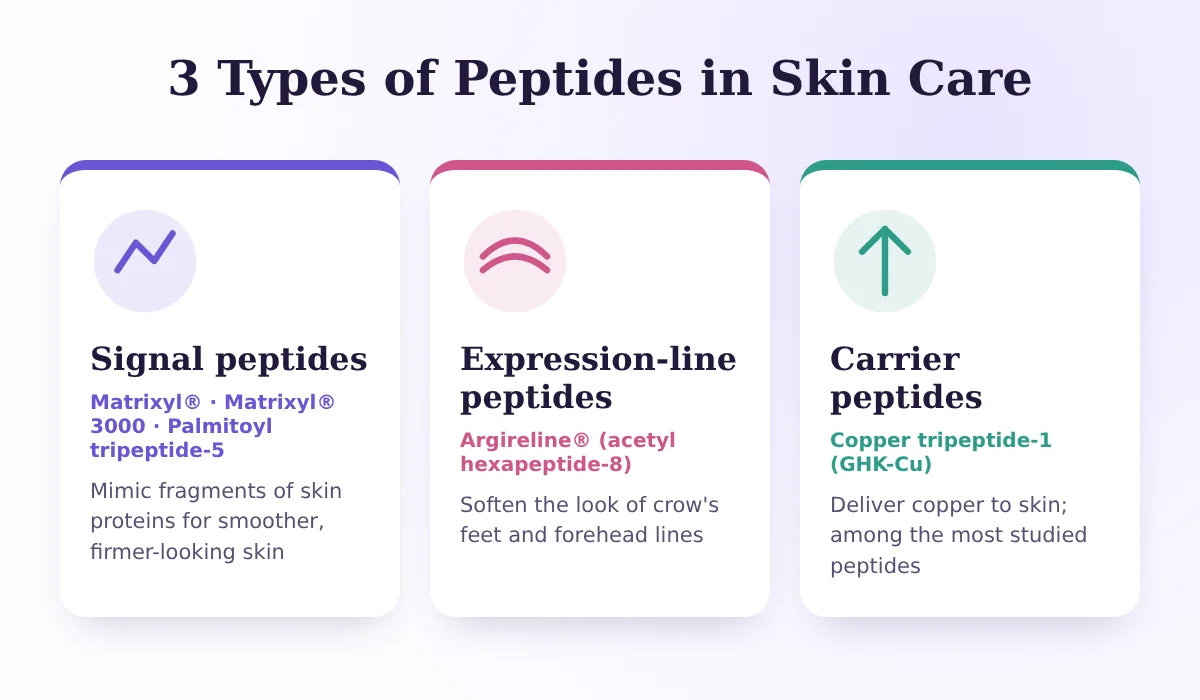
Signal peptides
Matrixyl® and Matrixyl® 3000
What it is: a trademarked family of peptides attached to a fatty acid to help them stay in the skin. The original is palmitoyl pentapeptide-4; Matrixyl® 3000 combines palmitoyl tripeptide-1 and palmitoyl tetrapeptide-7. Research: a 12-week placebo-controlled study of palmitoyl pentapeptide (Robinson et al., International Journal of Cosmetic Science, 2005) reported improvements in the appearance of fine lines and wrinkles. Found in: both creams.
Palmitoyl tripeptide-5
What it is: a signal peptide used in firming products. Found in: Revitol Eye Cream.
Neurotransmitter-modulating peptides
Argireline® (acetyl hexapeptide-8)
What it is: a six-amino-acid peptide designed to reduce the muscle signaling behind expression lines. Research: early studies (Blanes-Mira et al., International Journal of Cosmetic Science, 2002) found a modest reduction in wrinkle depth after 30 days. Reality check: it softens the look of crow's feet and forehead lines; it is not a substitute for injectables. Found in: both creams.
Carrier peptides
Copper tripeptide-1 (GHK-Cu)
What it is: a three-amino-acid peptide (glycine-histidine-lysine) bound to copper, first identified in human plasma. Research: reviews such as Pickart and Margolina (International Journal of Molecular Sciences, 2018) summarize its links to skin remodeling and improvements in the look of firmness and fine lines. Found in: both creams.
Eye-area actives
Eyeseryl® (acetyl tetrapeptide-5)
A peptide developed for the eye area and marketed for the look of under-eye puffiness. Found in: Revitol Eye Cream.
Caffeine
Can temporarily reduce the look of puffiness, which is why it is a staple of eye creams. Found in: Revitol Eye Cream.
Ectoin
A protective molecule originally found in microorganisms that live in extreme environments. In skin care it helps the skin hold water and feel less stressed. Found in: Revitol Eye Cream.
Supporting ingredients
Niacinamide (vitamin B3)
One of the best-supported cosmetic ingredients. A study at 5% (Bissett et al., Dermatologic Surgery, 2005) reported improvements in fine lines, blotchiness, redness and sallowness over 12 weeks. Found in: both (5% in the face cream).
Ceramides, cholesterol and fatty acids
The three lipids of the skin barrier. Formulas that include all three help reduce water loss and dryness. Found in: the face cream (the eye cream has a ceramide complex).
Hyaluronic acid and sodium PCA
Humectants that bind water in the outer skin for a smoother, plumper look. Found in: both.
Panthenol (B5) and squalane
Panthenol soothes and hydrates; squalane is a light, skin-identical emollient. Found in: both.
Antioxidants: vitamin E, green tea, resveratrol, CoQ10
Help protect skin from everyday environmental stress. They support, rather than replace, daily sunscreen. Found in: the face cream.
Bisabolol and allantoin
Soothing ingredients common in sensitive-skin products. Found in: the eye cream.
Putting it together
For the face, the Revitol Anti-Aging Peptide Cream combines three peptide types with niacinamide, barrier lipids and antioxidants. For the eye area, the Revitol Eye Cream adds Eyeseryl®, caffeine and ectoin that a face cream does not have.
Check Peptide Cream price →Official Revitol store · 60-day money-back guarantee
Check Eye Cream price →Official Revitol store · 60-day money-back guarantee
Frequently asked questions
What is the most effective peptide for wrinkles?
There is no single winner. The Matrixyl® family, copper tripeptide-1 and Argireline® have the most published research among cosmetic peptides, which is why formulas that combine them are appealing. Peptides also work better alongside proven ingredients like niacinamide, retinoids and daily sunscreen.
Are peptides safe for sensitive skin?
Peptides are generally considered low-irritation. Reactions are usually caused by other parts of a formula, such as fragrance. Patch test any new product.
Do copper peptides and vitamin C cancel each other out?
This is debated. As a precaution, many people use high-strength vitamin C in the morning and copper peptide products at night.
Are peptides the same as collagen?
No. Collagen is a large protein that cannot penetrate the skin when applied on top. Peptides are much smaller fragments designed to act as signals or carriers in the skin.